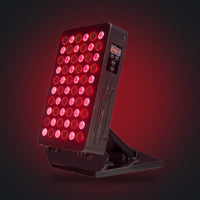
Is Red Light Therapy Safe? Side Effects, Contraindications, and Honest Guidance
Published May 25, 2026. Updated October 2026.
Quick answer
No guide can promise that a device suits everyone. Read the label, follow the device manual, and use eye protection as directed. Ask a doctor first if you have a medical condition, take medications, are pregnant, or have light sensitivity. Select devices carry FDA 510(k) clearance for specific, limited uses, and most light devices are sold as general wellness products, so read each product page and label.
Is red light therapy safe? Why we cannot give a blanket answer
People searching "is red light therapy safe" want a yes or no. The honest answer is that nobody can give a yes or no that applies to every person, every device and every way of using it. A responsible answer sends you to three places: the device label, the device manual, and a doctor if your situation involves anything on the list below. This guide explains how to use each of those. It does not make assurances, and it does not make claims about outcomes.
The same caution applies to any website, including ours. We sell these devices, so we publish how we write these guides. Use this guide as a checklist for reading your own paperwork.
Where reliable safety information comes from
- The label on the device and the box. It carries warnings that are specific to that model.
- The manual. It lists working distance, session time, eye protection and any people who should not use the device.
- The product page. It summarizes use and states what comes in the box, such as goggles on the AWA FX500 panel page.
- A doctor. Only a doctor who knows your history can say whether a given device is suitable for you.
Contraindications: when to ask a doctor first
"Contraindication" is simply a medical word for a situation in which something is not advised. The table lists situations in which you should ask a doctor before using a light device, not a description of what a device does.
| Situation | What to do before using a light device |
|---|---|
| You are pregnant or might be | Ask your doctor first and read what the manual says |
| You take medication, or a pharmacist has mentioned light sensitivity | Ask a doctor or pharmacist before use, and bring the device name and manual |
| You have a medical condition, or a history of skin cancer | Ask your doctor first. Do not rely on a general guide |
| You have an eye condition, or eyes that are sensitive to bright light | Ask a doctor first and follow the eye protection directions in the manual |
| Skin in the area is broken, irritated or recently had a skin procedure | Read the manual and ask a doctor before using the device there |
| The user is a child | Ask a pediatrician. Many devices are written for adult use, so check the label |
The general rule is the one we repeat in every guide: ask a doctor first if you have a medical condition, take medications, are pregnant, or have light sensitivity.
Side effects: what people ask about and what to do
We do not know of a basis for claiming that anyone will or will not react to a light device. We can list reactions people commonly ask about and a sensible next step for each. This list is not a prediction and not a diagnosis.
| Reaction people ask about | What a sensible next step looks like |
|---|---|
| Skin that looks flushed or feels warm after a session | Stop, let the skin settle, and check the distance and time against the manual |
| Eye discomfort or seeing spots after bright light | Stop, use eye protection as directed next time, and see a doctor if it persists |
| Headache or feeling unwell during a session | Stop the session and contact a doctor if it continues |
| Feeling too hot, dizzy or lightheaded (heat devices) | Stop, cool down, and follow the temperature and time directions in the manual |
| Anything that worries you | Stop, note what you used, and contact a doctor or the AWA team |
Eyes need their own plan
Bright light aimed at the face is uncomfortable to look at, and near infrared at 850 nm is mostly invisible, so brightness does not tell you how much light there is. Use eye protection as directed in your manual. Face masks are designed to sit over the eyes with shielding, and panels may include goggles. See our eye protection guide for a longer discussion.
Distance and time matter to the numbers
Following the manual is not only a formality. It controls the light that reaches you. Arithmetic example: the FX500 is stated at 73.8 mW/cm² at 12 inches and 220 mW/cm² at 2 inches. For 10 minutes (600 seconds), 73.8 x 600 / 1000 = 44.3 J/cm², while 220 x 600 / 1000 = 132 J/cm². Same clock time, roughly three times the energy, just from sitting closer. The product pages list about 6 to 12 inches, so use the distance in your manual. More on this in the guide to going beyond a manual and the dose calculation guide.
Heat devices are a different category
Panels and masks mainly emit light. Devices such as sauna blankets and heating mats are designed to get warm. Their manuals will have their own directions on temperature, time and who should not use them. Do not assume the guidance for a light panel carries over to a heated device.
How devices are regulated, in plain terms
Regulation is a separate question from personal suitability, and it is easy to misread. In brief:
- Select devices carry FDA 510(k) clearance for specific, limited uses. A 510(k) is a premarket submission showing a device is substantially equivalent to a legally marketed device. See the FDA page below.
- Most light devices are sold as general wellness products, which FDA addresses in a separate policy guidance.
- FDA states that LEDs are not subject to the federal laser product performance standard, which applies to lasers.
- Read each product page and label to see what applies to the device in front of you.
None of these items is a statement that a device suits any particular person. Clearance covers specific uses, and the manual still governs how you use the device.
Common mistakes
- Using a general article, including this one, as a substitute for the manual or a doctor.
- Assuming a cleared device and a general wellness device carry the same labeling. Read each page and label.
- Skipping eye protection because the light looks mild.
- Using a device while taking medication without checking with a doctor or pharmacist.
- Sitting closer than the manual says to shorten a session.
- Carrying over directions from a light panel to a heated device.
- Continuing through a reaction instead of stopping and checking.
Before you use any light device: read the label, follow the device manual, and use eye protection as directed. Ask a doctor first if you have a medical condition, take medications, are pregnant, or have light sensitivity.
Related guides in this series
- Eye protection and goggles guide
- Using a device beyond its manual
- How long a session runs, by the manual
- Red light therapy myths guide
- 660nm vs 850nm wavelength guide
Device pages
Read the full page and label for each device before you use it: AWA FX500 panel, AWA LX300 face mask. You can also browse all AWA red light therapy devices.
Frequently asked questions
Is red light therapy safe for everyone?
No guide can say that. Suitability depends on the person, the device and how it is used. Read the label, follow the manual, and ask a doctor if you have a medical condition, take medications, are pregnant, or have light sensitivity.
Who should ask a doctor before using a light device?
Anyone with a medical condition, anyone who takes medications, anyone who is pregnant, and anyone with light sensitivity should ask a doctor first. A pharmacist can also answer questions about specific medications.
Do I need eye protection?
Use eye protection as directed in your device manual. Near infrared at 850 nm is mostly invisible, so how bright the light looks is not a reliable guide.
What does FDA 510(k) clearance mean?
A 510(k) is a premarket submission showing a device is substantially equivalent to a legally marketed device. Select devices carry clearance for specific, limited uses, and most light devices are sold as general wellness products. Read each product page and label.
What should I do if I have a reaction during a session?
Stop the session, check the manual against what you used, and contact a doctor if the reaction continues or you are worried. You can also contact the AWA team with the details.
Sources
- FDA: General Wellness policy guidance (CDRH). Final guidance dated January 2026 that sets out the agency's compliance policy for general wellness products. It is a policy document, not a statement about any one device.
- FDA: Premarket Notification 510(k). Explains that a 510(k) is a premarket submission showing a device is substantially equivalent to a legally marketed device, and that a company must receive an FDA order clearing the device before marketing it in the U.S.
- FDA: Laser Products and Instruments. Describes FDA laser hazard classes I to IV, notes that higher classes carry warning labels, and states that LEDs are not subject to the federal laser product performance standard.
- OSHA: Laser Hazards Overview. States that the human eye is almost always more vulnerable to injury than skin. The page is about lasers, not LED devices; we cite it only for the general point that eyes deserve separate attention.
Regulatory note: select devices carry FDA 510(k) clearance for specific, limited uses. Most light devices are sold as general wellness products. Read each product page and label.
How we create this guide
AWA sells red light therapy devices. We write these guides to explain how devices work and how to choose and use one. This is general information, not medical advice. Read each product page and label. See our editorial standards.