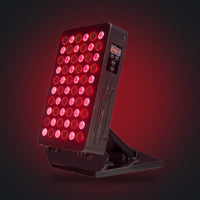
How Long Should You Do Red Light Therapy? A Session Length Guide
Published June 8, 2026. Updated October 2026.
Quick answer
There is no universal session length. Time and distance come from your device manual and product page, and they differ by device. For example, the AWA FX300 page says 10 to 15 minutes a day at about 6 to 12 inches, while the LX300 mask page says about 10 minutes, 3 to 4 times a week. This guide adds arithmetic, not a target.
Session length is set by the device, not by a rule of thumb
"How long should you do red light therapy?" is one of the most searched questions about these devices, and the honest answer is that it depends on the device in your hands. Different devices have different irradiance, different working distances and different intended use areas. Internet rules like "always 20 minutes" ignore all of that.
This guide does not give a target time or make claims about outcomes. It shows where the session guidance actually lives, how to turn it into a plan, and how to do the arithmetic if you want to understand what a given session delivers.
Where session guidance lives
- The manual that ships with the device. This is the first source and the one that governs.
- The product page. It often summarizes distance and time in a short line.
- The label and any on device timer settings. Some devices shut off by themselves after a preset time.
If these disagree with something you read in a guide, follow the manual and ask the maker if it is unclear.
What AWA product pages say
These are the usage lines currently published on four AWA product pages. We copy them here so you can see how much they vary by device.
| Device | What the product page says about use | Weekly minutes (arithmetic) |
|---|---|---|
| AWA FX300 panel | 10 to 15 minutes a day, about 6 to 12 inches from the area | Daily at 10 minutes is 7 x 10 = 70. Daily at 15 minutes is 7 x 15 = 105. |
| AWA FX500 panel | 10 to 15 minutes a day at about 6 to 12 inches; remote with auto off timer | Daily at 10 minutes is 70. Daily at 15 minutes is 105. |
| AWA LX300 face mask | About 10 minutes a session, 3 to 4 times a week | 3 x 10 = 30 up to 4 x 10 = 40. |
| AWA LX500 face mask | 10 to 20 minutes, 4 to 6 times a week | 4 x 10 = 40 up to 6 x 20 = 120. |
Session guidance is copied from each live product page as of October 2026. If a page changes, the page wins over this guide.
Notice that a face mask page and a panel page do not agree on time or frequency. They describe different devices used on different areas, which is why a single universal number does not exist.
What a session delivers: arithmetic examples
If you want to understand the physics behind a session, use the dose formula from our dose calculation guide: J/cm² = mW/cm² x seconds / 1000. The table below applies it to the session times that appear on the panel product pages.
| Panel and distance | Stated irradiance (mW/cm²) | 10 min (600 s) | 15 min (900 s) |
|---|---|---|---|
| FX300 at 6 inches | 83.5 | 50.1 | 75.2 |
| FX300 at 12 inches | 43.3 | 26.0 | 39.0 |
| FX500 at 6 inches | 94 | 56.4 | 84.6 |
| FX500 at 12 inches | 73.8 | 44.3 | 66.4 |
Energy in J/cm² for one session. Arithmetic examples using irradiance figures from the AWA irradiance specs guide. They describe the light emitted, not what a session should be.
Arithmetic example: FX500 at 6 inches for 15 minutes. 94 mW/cm² x 900 seconds = 84,600 mJ/cm². Divide by 1000 to get 84.6 J/cm². The same 15 minutes at 12 inches gives 73.8 x 900 / 1000 = 66.4 J/cm².
Two points follow from the table. First, distance changes the energy for the same clock time, so "how many minutes" is never a complete question. Second, a longer clock time at a greater distance can land near the energy of a shorter time up close on the same panel. Both are arithmetic facts, not recommendations.
Building a plan you can follow
Step 1: note your device's distance and time
Write down the working distance and the session time from the manual or product page. If you use a panel, mark the distance on the floor or with a piece of tape so you sit in the same place each time.
Step 2: use a timer
If the device has an auto off timer, set it. The AWA FX500 panel page lists a remote with an auto off timer. If your device does not have one, use a phone timer so a session does not run long by accident.
Step 3: keep a short log
Record the date, the distance and the time. A log makes it easy to see whether you are following the manual, and it gives you something concrete to bring to a doctor or to the AWA team if you have questions.
Step 4: change one thing at a time
If you decide to change distance or time after reading the manual again, change one variable and note it. Changing both makes the arithmetic hard to follow.
Weekly minutes are just addition
Weekly totals are useful for planning around a busy calendar. For a device used 4 times a week at 15 minutes, the total is 4 x 15 = 60 minutes. Several areas in the same day multiply the minutes quickly: three areas at 10 minutes each is 30 minutes of clock time that day. Totals tell you about your schedule. They do not tell you whether an amount suits you. The manual does that.
Common mistakes
- Copying a session length from a video or forum for a different device.
- Changing the time without noting the distance, or the other way around.
- Running two or more devices on the same area in one sitting without reading what each manual says.
- Skipping the timer and letting a session run long while distracted.
- Assuming a face mask and a panel follow the same schedule.
- Reading a weekly total as a target rather than as a scheduling number.
Before you use any light device: read the label, follow the device manual, and use eye protection as directed. Ask a doctor first if you have a medical condition, take medications, are pregnant, or have light sensitivity.
Related guides in this series
- How to calculate a red light therapy dose
- Using a device beyond its manual
- Fitting a session into your day
- What irradiance means on a spec sheet
- AWA FX300 and FX500 irradiance specs
Device pages
Read the full page and label for each device before you use it: AWA FX300 panel, AWA FX500 panel, AWA LX300 face mask. You can also browse all AWA red light therapy devices.
Frequently asked questions
How long should a red light therapy session be?
It depends on the device. Session time and distance are set by the manual and product page for that device. For example, the AWA FX300 page lists 10 to 15 minutes a day at about 6 to 12 inches.
Why do a mask and a panel have different session guidance?
They are different devices with different output, working distance and use area, so the manufacturer publishes separate guidance for each.
Does sitting closer change the energy delivered?
Yes, as arithmetic. Irradiance is higher at shorter distances, so the same clock time delivers more J/cm². Use the distance listed in your manual.
Is a timer necessary?
A timer is a practical way to keep a session to the time in your manual. Some devices include an auto off timer, and a phone timer covers the rest.
Can I add up weekly minutes to decide how much is right?
Weekly minutes are only a scheduling number. They do not say what suits you. Follow the manual and ask a doctor if you have questions about your situation.
Sources
- FDA: General Wellness policy guidance (CDRH). Final guidance dated January 2026 that sets out the agency's compliance policy for general wellness products. It is a policy document, not a statement about any one device.
- FDA: Premarket Notification 510(k). Explains that a 510(k) is a premarket submission showing a device is substantially equivalent to a legally marketed device, and that a company must receive an FDA order clearing the device before marketing it in the U.S.
- FDA: Laser Products and Instruments. Describes FDA laser hazard classes I to IV, notes that higher classes carry warning labels, and states that LEDs are not subject to the federal laser product performance standard.
Regulatory note: select devices carry FDA 510(k) clearance for specific, limited uses. Most light devices are sold as general wellness products. Read each product page and label.
How we create this guide
AWA sells red light therapy devices. We write these guides to explain how devices work and how to choose and use one. This is general information, not medical advice. Read each product page and label. See our editorial standards.