Do You Need Eye Protection for Red Light Therapy?
Published June 21, 2026. Updated October 2026.
Quick answer
Use eye protection as your device manual directs. The AWA FX500 page lists goggles in the box, and the LX300 and LX500 pages describe an eye shielded mask design. Near infrared at 850nm is mostly invisible, so how bright a light looks is not a reliable guide. Ask a doctor first if you have an eye condition, a medical condition, take medications, are pregnant, or have light sensitivity.
Do you need eye protection for red light therapy?
This is one of the most common questions we get, and the honest answer comes in two parts. First, the instruction that governs is the one in your device manual: use eye protection as directed. Second, we do not make claims about whether eye protection is or is not needed for any person, because that depends on the device, the mode, the distance and your own eyes. A doctor is the right person for the last of those.
What this guide can do is help you read your own paperwork, explain why eyes deserve a separate plan from skin, and show some arithmetic about distance.
Why eyes get their own section
OSHA's overview of laser hazards states that the human eye is almost always more vulnerable to injury than skin. That page is about lasers, not LED devices, and we do not suggest the two are the same. We cite it only for the general idea that the eye deserves separate attention from skin when a bright light source is involved.
Two practical points follow for LED devices. First, a panel at close range can be bright enough to be uncomfortable to look at. Second, near infrared at 850nm is mostly invisible, so brightness is not a reliable cue for how much light is present. You will not always notice what you cannot see.
LEDs and lasers are labeled differently
FDA recognizes laser hazard classes I to IV, with warning labels on higher classes, and states that LEDs are not subject to the federal laser product performance standard. That means a warning you have read about lasers is not automatically the warning for an LED panel, and the reverse. Read the label and manual for your device rather than carrying over what you saw in a laser context.
What AWA product pages say about eyes
| Device type | Eye related point on the product page | What to check in the manual |
|---|---|---|
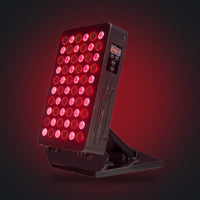
| Panel, the AWA FX500 | The page lists goggles among the items included, along with a remote and a foldable stand | How and when to wear the goggles, and the working distance |
| Panel, the AWA FX300 | The page does not list box contents; use the manual that ships with it | Whether goggles are included, and what the manual says about eyes |
| Face mask, the AWA LX300 and LX500 | Both pages describe the design as eye shielded | Whether to keep eyes closed, and any directions on blue or other color modes |
| Multi color mode with blue (415nm on the LX300 page) | Blue is a visible, short wavelength mode | Any extra directions the manual gives for that mode |
| Wearables and handheld devices | Not reviewed in this guide; read the page for your model | Whether the manual says to keep the device away from the eyes |
Eye related points come from AWA product pages as of October 2026. If a page and the manual differ, follow the manual.
The AWA FX500 panel page lists goggles in the box. The AWA LX300 face mask and AWA LX500 face mask pages describe an eye shielded mask design. Those are product facts, not promises about what a user will experience. Wear eye protection as the manual directs.
Arithmetic: distance and short looks
The energy formula from our dose calculation guide is J/cm² = mW/cm² x seconds / 1000. Applying it to short times shows how quickly the numbers rise close to a panel.
| Stated irradiance | Looking at the panel for 5 s | Looking at the panel for 10 s |
|---|---|---|
| 94 mW/cm² (FX500, 6 inches) | 0.47 J/cm² | 0.94 J/cm² |
| 220 mW/cm² (FX500, 2 inches) | 1.10 J/cm² | 2.20 J/cm² |
| 43.3 mW/cm² (FX300, 12 inches) | 0.22 J/cm² | 0.43 J/cm² |
Arithmetic examples of the energy formula applied to short times. Panel face irradiance is not the same as irradiance at an eye, and the table makes no claim about what any number does to an eye. It shows how quickly the figures grow close to a panel.
Arithmetic example: 220 mW/cm² x 10 seconds = 2,200 mJ/cm², and 2,200 / 1000 = 2.2 J/cm². At 94 mW/cm², the same 10 seconds gives 0.94 J/cm². The close figure is more than twice the far one. The panel figures come from our irradiance specs guide, and the comparison is the reason a manual sets a working distance.
Choosing and using eye protection
- Use what the manual names. If goggles ship with the device, those are the ones the maker expects you to use.
- Do not assume sunglasses are a match. They are designed for sunlight. Unless your manual says otherwise, use the protection it specifies.
- Know your modes. Check whether the blue mode on a multi color mask has extra directions.
- Keep the working distance. Do not move a panel closer to your face to shorten a session.
- Stop if it is uncomfortable. If a light feels too bright, or your eyes feel strained during or after a session, stop and check the manual.
- Ask a doctor. If you have an eye condition, take medication that affects light sensitivity, or are pregnant or have a medical condition, ask a doctor before using a light device.
Masks and the eyes
A mask is worn directly on the face, so eye directions are especially important. The AWA mask pages describe an eye shielded design, and the LX300 page adds that it is hands free. Read the manual for whether to keep your eyes closed, how to seat the mask, and any limits on color modes. If the fit feels wrong, adjust it before the session starts rather than during. Our short guide on whether to keep your eyes open or closed covers the same question in plain terms, and our guide to choosing a red light therapy mask lists what to check before you buy one.
Common mistakes
- Skipping goggles because the light looks dim. Near infrared is mostly invisible.
- Looking directly at a panel to check whether it is on.
- Assuming a warning for lasers applies in full, or not at all, to an LED panel.
- Using sunglasses instead of the protection the manual names.
- Moving a panel closer to the face to save time.
- Ignoring eye directions for a blue or multi color mode.
- Applying a guide like this one in place of your manual or a doctor.
Before you use any light device: read the label, follow the device manual, and use eye protection as directed. Ask a doctor first if you have a medical condition, take medications, are pregnant, or have light sensitivity.
Related guides in this series
- Red light therapy safety checklist
- Using a device beyond its manual
- 660nm vs 850nm wavelength guide
- How to calculate a red light therapy dose
- AWA FX300 and FX500 irradiance specs
Device pages
Read the full page and label for each device before you use it: AWA FX500 panel, AWA LX300 face mask, AWA LX500 face mask. You can also browse all AWA red light therapy devices.
Frequently asked questions
Do I need goggles for red light therapy?
Use eye protection as directed in your device manual. The AWA FX500 page lists goggles among the items included, and the LX300 and LX500 pages describe an eye shielded mask design.
Why is near infrared a special case for eyes?
Near infrared at 850nm is mostly invisible, so how bright the light looks is not a reliable guide to how much light there is.
Are LED devices labeled like lasers?
FDA states that LEDs are not subject to the federal laser product performance standard, so warnings written for lasers are not automatically the warnings for an LED device. Read the label and manual for your device.
Can I use sunglasses instead of the included goggles?
Use the eye protection your manual names. Sunglasses are designed for sunlight, so do not assume they are a match unless the manual says so.
Who should ask a doctor before using a light device near the face?
Anyone with an eye condition, a medical condition, anyone who takes medications, anyone who is pregnant, and anyone with light sensitivity should ask a doctor first.
Sources
- OSHA: Laser Hazards Overview. States that the human eye is almost always more vulnerable to injury than skin. The page is about lasers, not LED devices; we cite it only for the general point that eyes deserve separate attention.
- FDA: Laser Products and Instruments. Describes FDA laser hazard classes I to IV, notes that higher classes carry warning labels, and states that LEDs are not subject to the federal laser product performance standard.
- FDA: General Wellness policy guidance (CDRH). Final guidance dated January 2026 that sets out the agency's compliance policy for general wellness products. It is a policy document, not a statement about any one device.
- FDA: Premarket Notification 510(k). Explains that a 510(k) is a premarket submission showing a device is substantially equivalent to a legally marketed device, and that a company must receive an FDA order clearing the device before marketing it in the U.S.
Regulatory note: select devices carry FDA 510(k) clearance for specific, limited uses. Most light devices are sold as general wellness products. Read each product page and label.
How we create this guide
AWA sells red light therapy devices. We write these guides to explain how devices work and how to choose and use one. This is general information, not medical advice. Read each product page and label. See our editorial standards.