Red Light Therapy Device Types Explained: Panels, Masks, Belts, Blankets and Handhelds
Published October 2026. Updated October 2026.
Quick answer
Red light therapy devices come in two families. Light devices (panels, masks, belts, slippers, handhelds and torches) emit LED light and are described by wavelength and irradiance. Heat devices (sauna blankets and heating mats) warm you and are described by temperature and a timer. Pick the type that fits your space, your posture and the area you want to cover, then read the one spec that matters for that type. This guide is about equipment, not outcomes.
The two families of devices
Almost every home device falls into one of two groups, and mixing them up is the most common buying mistake.
- Light devices use LEDs at set wavelengths, usually red around 660nm and near infrared around 850nm. The key numbers are wavelength, irradiance in mW/cm² and the distance that irradiance was measured at.
- Heat devices use infrared heating elements to warm a blanket or mat. The key numbers are the temperature range, the timer and the size.
A light device is not a heater, and a heater is not a light device. Our red light versus infrared sauna guide covers that split in more depth.
Light device types
Each type below is defined by where the light sits relative to you.
| Type | Where the light sits | Coverage at one time | Spec to read first |
|---|---|---|---|
| Panel | Away from you, at a stated distance | Large, set by distance | Irradiance at a named distance |
| Face mask | Against the face | The face | Light modes in nm |
| Belt or wrap | Against the skin | The wrapped area | Wavelengths and the manual |
| Slippers | Around the feet | The feet | Wavelengths and the manual |
| Handheld or torch | A few inches from one spot | A small spot | Wavelengths and battery |
| Pad or mat | Under or against you | A flat area | Wavelengths and the manual |
Panels
A panel is a flat frame of LEDs you stand or hang in front of you. Because light spreads with distance, panel specs only make sense with a distance attached. The FX300 is stated at 83.5 mW/cm² at 6 inches and the FX500 at 94 mW/cm² at 6 inches. See the AWA irradiance specs guide for the full distance table.
Wearables
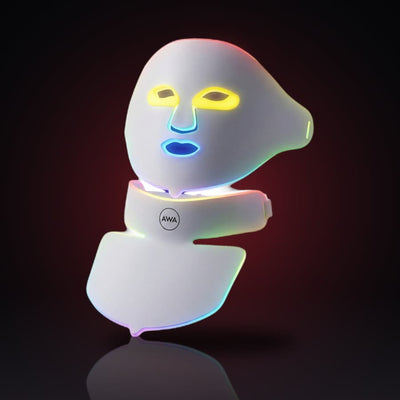
Masks, belts, wraps and slippers sit against the body, so fit matters more than distance. Check how many LEDs touch the area, how the strap or shell sits and how long the cable or battery lasts.
Handhelds and torches
These are small and portable and are aimed at one spot at a time. They suit people who want to carry something in a bag, not people who want one device to cover a large area.
Heat device types
| Type | How it is used | Spec to read first |
|---|---|---|
| Sauna blanket | You lie wrapped in a heated blanket | Temperature range, timer, lining |
| Heating mat | You lie on a heated mat | Heat levels, auto shut off, size |
The HL500 lists six heat levels and a timer that runs up to 60 minutes with auto shut off. A heat device has no irradiance figure because it is not emitting LED light at a measured intensity. OSHA notes that hazardous heat can occur indoors or outdoors and that clothing that traps body heat adds to the risk, so read the heat guidance in the manual before the first session.
Worked example: reading one spec per type
Spec sheets do not look alike, so here is what to pull from each. These numbers are example numbers for arithmetic only, except the FX500 figure, which is an AWA stated value.
- Panel. FX500 at 6 inches is stated at 94 mW/cm². For 5 minutes (300 seconds): 94 x 300 / 1000 = 28.2 J/cm². That is energy per square centimeter, and it is arithmetic, not a target.
- Wearable. A made up belt lists 660nm and 850nm LEDs but no irradiance. You cannot calculate J/cm² from that sheet. Ask for the irradiance at the skin surface, or use the manual.
- Heat blanket. A made up blanket lists 95 to 185°F and a 60 minute maximum timer. There is no mW/cm² figure to find, and that is normal.
How to choose between types
Start with the practical constraint, then match the spec.
- Space. A stand needs floor room. A mask, belt or handheld does not.
- Posture. Masks, blankets and mats are used lying down. Panels are used sitting or standing. Belts and slippers let you stay seated.
- Area. A panel lights a large area from a distance. A wearable covers only what it touches.
- Warmth or light. If you want warmth, you want a heat device. If you want light at set wavelengths, you want a light device.
Use the AWA device comparison page to see AWA models side by side.
Common mistakes
- Assuming heat and light devices are interchangeable.
- Comparing devices by LED count or total watts instead of irradiance at a stated distance.
- Buying a large format for a small room.
- Ignoring the manual for session time, distance and temperature.
- Assuming a wearable lights a large area.
- Reading a regulatory term as a promise. Select devices carry FDA 510(k) clearance for specific, limited uses; most are sold as general wellness products.
Before you use any light or heat device: read the label, follow the device manual, and use eye protection as directed. Ask a doctor first if you have a medical condition, take medications, are pregnant, or have light or heat sensitivity.
Related guides
- Red light therapy formats guide
- Red light therapy buyers checklist for home use
- Wavelengths, sessions and devices explained
Device pages
Read the full page and label for each device before you use it: AWA FX500 panel, AWA red light therapy belt, AWA HL500 sauna blanket. You can also browse AWA red light therapy devices.
Frequently asked questions
How many types of red light therapy device are there?
There are six common light formats: panels, face masks, belts or wraps, slippers, handhelds or torches, and pads or mats. Sauna blankets and heating mats are heat devices and are a separate family.
Which type covers the biggest area?
A panel usually lights the largest area in one position. How much depends on the distance you place it at.
Do all types list irradiance?
No. Panels usually do, and many wearables do not. Heat devices do not, because they are described by temperature and a timer.
Is a sauna blanket a light device?
No. It is a heater. Its specs are temperature range, timer and size, not wavelength and irradiance.
Where do I find session time and distance?
In the manual and on the product page for your specific device. This guide explains types and does not set session times.
Sources
- FDA: General Wellness policy guidance. A final guidance dated January 2026 that sets out the agency's compliance policy for low risk general wellness products. It is a policy document, not a statement about any one device.
- FDA: Premarket Notification 510(k). Explains that a 510(k) is a premarket submission and that the company must receive an FDA order before marketing the device in the U.S.
Regulatory note: select devices carry FDA 510(k) clearance for specific, limited uses. Most light devices are sold as general wellness products. Read each product page and label.
How we create this guide
AWA sells red light therapy devices. We write these guides to explain how devices work and how to choose and use one. This is general information, not medical advice. Read each product page and label. See our editorial standards.