Handheld Red Light Devices Versus Panels: Coverage, Battery and Practical Trade Offs
Published October 2026. Updated October 2026.
Quick answer
A handheld is small, rechargeable and aimed at one spot at a time, so you hold it close and move it. A panel stays still and lights a wider area from a stated distance. The real trade off is coverage versus convenience: the more area you want to cover, the more positions a handheld needs. Panels list irradiance at a distance, and handhelds often list wavelengths and battery. Choose by the size of the area, how portable you need to be and whether you want your hands free.
Two tools built for different jobs
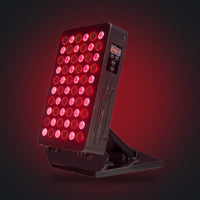
A handheld is a pocket or palm sized light device you point at one place. AWA's handheld is the 3 in 1 Red Light Torch, which offers red, near infrared and blue light and is made for quick, targeted use. A panel, such as the FX300 or FX500, is a larger fixed array you face from a distance.
Neither one is a better version of the other. A handheld gives you reach and portability, and a panel gives you area and hands free time.
Head to head
| Question | Handheld | Panel |
|---|---|---|
| Coverage per position | A small spot | A wide area |
| Hands | One hand holds it | Free |
| Power | Rechargeable battery | Wall outlet |
| Portability | Fits a bag | Foldable stand or hook |
| Distance control | You hold it | Set by where you stand |
| Spec to read first | Wavelengths, battery, spot size | Irradiance at a named distance |
| Best at | Small, specific areas | Larger areas in one position |
The coverage arithmetic most people skip
The honest question is how many positions a handheld needs to cover your target area. These are example numbers for arithmetic only.
- Suppose a handheld's lit window is about 60 cm² (for example 10 cm by 6 cm).
- Suppose the area you want to cover is about 600 cm².
- 600 / 60 = 10 positions, assuming no overlap and a perfect fit.
- If you spend 3 minutes in each position, that is 30 minutes of total session time, and your arm has held the device for all of it.
A panel facing the same area from a stated distance lights the whole area at once. The FX300 is stated at 83.5 mW/cm² at 6 inches and the FX500 at 94 mW/cm² at 6 inches. Neither figure says how long to use it. Use the manual, and the dose calculator to do the arithmetic.
Example numbers for arithmetic only. They are not a session recommendation and not AWA specifications.
Where a handheld makes sense
- Small, specific spots where a panel is clumsy to aim.
- Travel and desk drawers. It charges by cable and fits in a bag. See our travel devices guide.
- Second device. Many people keep a handheld alongside a panel, using the panel for wide areas and the handheld for spots.
In the AWA line, the handheld option is the 3 in 1 Red Light Torch. It is small enough to keep in a bag or a drawer, and it pairs well with a panel such as the FX300 or FX500 when you also want broader coverage. Check its product page for the current details before you decide.
Where a panel makes sense
- Wider areas. One position lights much more than a handheld can.
- Hands free sessions. You can stand, sit or read.
- Repeatable distance. A mark on the floor or a stand setting keeps distance consistent, which matters because irradiance changes with distance.
- Sharing a device. Anyone in the home can stand in front of it.
Safety and handling
Handhelds are held close, so read the manual for the closest recommended distance. Eye protection matters for any bright LED device, and our eye protection guide explains what to look for. The FDA notes that LEDs differ from laser diodes and are not subject to the federal laser product performance standard, so a handheld LED device is a different product class from a laser pointer. Follow the label for the specific device in your hand.
Holding a handheld consistently
Because you control the distance by hand, consistency takes a little practice.
- Pick a distance the manual allows and use a ruler once to learn what it looks like.
- Rest your elbow on a table or armrest so the device does not drift.
- Move in a set order, such as left to right, so you do not skip or double up spots.
- Use the built in timer or a phone timer for each position, and keep the same count each time.
- Put the device down if your arm tires, rather than shortening the distance to compensate.
Buying checklist for a handheld
- Wavelengths listed in nm.
- Battery capacity and charge time in the manual.
- A built in timer or auto shut off.
- Weight and grip, since you will hold it.
- Whether it comes with eye protection.
- A stated irradiance and distance, if the maker publishes them.
For the AWA 3 in 1 Red Light Torch, read the product page for the current spec list, since this guide does not repeat figures that are not confirmed.
Common mistakes
- Buying a handheld for a large area and finding it slow.
- Holding it closer or farther than the manual says and assuming the output is the same.
- Comparing a handheld's LED count with a panel's irradiance.
- Forgetting that battery life limits session length.
- Skipping eye protection because the device looks small.
- Ignoring the manual for session time, since a blog cannot set it for your device.
Before you use any light or heat device: read the label, follow the device manual, and use eye protection as directed. Ask a doctor first if you have a medical condition, take medications, are pregnant, or have light or heat sensitivity.
Related guides
- Panel versus mask versus belt
- Best red light devices for travel
- Eye protection for light devices
- What irradiance means and why it matters
- FX300 versus FX500
Device pages
Read the full page and label for each device before you use it: AWA 3 in 1 Red Light Torch, AWA FX300 panel. You can also browse AWA handheld devices.
Frequently asked questions
Is a handheld or a panel better?
Neither is better in general. A handheld suits small spots and travel, and a panel suits wider areas and hands free sessions.
Why does a handheld need more positions?
Its lit window is small, so covering a larger area means moving it. The more area, the more positions.
Is a handheld LED device a laser?
No. The FDA describes LEDs as different from laser diodes and not subject to the federal laser product performance standard. Read the label for your own device.
Does a handheld list irradiance?
Some do and many do not. If it is missing, you cannot calculate J/cm² from the spec sheet.
Where do I find session time?
In the manual and on the product page for your device. This guide compares formats and does not set session times.
Sources
- FDA: General Wellness policy guidance. A final guidance dated January 2026 that sets out the agency's compliance policy for low risk general wellness products. It is a policy document, not a statement about any one device.
- FDA: Laser Products and Instruments. Describes the four FDA laser hazard classes, notes that classes II to IV carry warning labels, and states that LEDs differ from laser diodes and are not subject to the federal laser product performance standard.
Regulatory note: select devices carry FDA 510(k) clearance for specific, limited uses. Most light devices are sold as general wellness products. Read each product page and label.
How we create this guide
AWA sells red light therapy devices. We write these guides to explain how devices work and how to choose and use one. This is general information, not medical advice. Read each product page and label. See our editorial standards.