Is a More Expensive Red Light Panel Worth It? Where the Money Goes
Published October 2026. Updated October 2026.
Quick answer
A higher price is worth it only when it buys something you can check and will use: stated irradiance at a distance, better heat handling, a mount or remote you want, clear support terms. Price on its own proves nothing. Compare panels at the same distance on mW/cm², then compare box contents and return terms. On AWA, the FX500 costs 35 percent more than the FX300 and states 12.6 percent higher irradiance at 6 inches and about 70 percent higher at 12 inches.
Start with what you can verify
Shoppers often ask whether the cheaper devices work the same as the expensive ones. That question is too loose to answer. A better one is: what exactly does the extra money buy, and can I see it on the page? A real difference shows up as a number, a part, a document or a term. A vague difference shows up as an adjective.
Nothing here claims what any panel will do for you. We only compare what a device states about itself.
Where the extra money can go
| What a higher price may fund | How to check it |
|---|---|
| Higher irradiance at a stated distance | Look for mW/cm² with a distance. Ask for the method if it is missing. |
| Better heat handling (heat sinks, cooling) | Look for a description of cooling, and a stated running time. Check reviews for how warm the unit gets in use. |
| Sturdier build and mounting | Look at stated dimensions, materials and the mount. Check what is included in the box. |
| Convenience features (remote, stand, timer) | Check the box contents and feature list. |
| Testing and documentation | Look for a manual, labeled specs and clear safety guidance. |
| Support and return terms | Read the warranty and return pages before you buy. |
| Brand and marketing spend | Not a feature. Do not pay for it if the page gives you nothing else. |
Notice the last row. A share of any retail price goes to advertising and brand, and that part buys you nothing you can measure. This is why it helps to compare the checkable rows first.
A worked example from AWA published numbers
Here is a real comparison using AWA prices on October 14, 2026 and the published irradiance numbers from the irradiance specs guide.
| Measure | FX300 | FX500 | FX500 versus FX300 |
|---|---|---|---|
| Price | $199.99 | $269.99 | $70.00 more, about 35 percent |
| Irradiance at 6 inches | 83.5 mW/cm² | 94 mW/cm² | About 12.6 percent higher |
| Irradiance at 12 inches | 43.3 mW/cm² | 73.8 mW/cm² | About 70 percent higher |
| Energy for 10 minutes at 6 inches | 50.1 J/cm² | 56.4 J/cm² | Arithmetic from the stated numbers |
| Energy for 10 minutes at 12 inches | 26.0 J/cm² | 44.3 J/cm² | Arithmetic from the stated numbers |
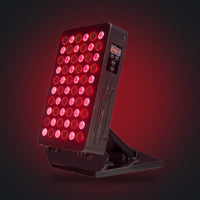
| Form | Hanging panel with rope | Foldable stand panel with remote |
Energy figures use J/cm² = mW/cm² x seconds / 1000 with the stated irradiance. They are arithmetic from specs, not a recommended session and not a promise about outcomes.
What the table shows: the extra $70 buys a stand, a remote and a more even drop in irradiance as you move back from the panel. If you plan to sit 6 inches away, the gap in the number is small. If you plan to sit 12 inches away, the gap is large. Whether that is worth $70 depends on where you will actually put the panel. It is a fair thing to decide on your own, with the numbers in front of you.
Price per unit of irradiance, and why it flips
A rough value test is to divide price by irradiance at the same distance. It is a blunt tool, but it shows an important point.
| Distance | FX300 price per mW/cm² | FX500 price per mW/cm² |
|---|---|---|
| 6 inches | $2.40 | $2.87 |
| 12 inches | $4.62 | $3.66 |
Price divided by the stated irradiance. Prices as shown October 14, 2026.
At 6 inches the FX300 gives a lower price for each mW/cm². At 12 inches the FX500 does. The cheaper panel is not always the better value, and the dearer one is not either. It depends on the distance you will use. Use the irradiance by distance chart to see the full range for both panels.
When a higher price is not worth it
- The spec sheet shows no improvement you will use.
- The extra cost buys a feature you will leave in the box.
- You will sit at a distance where both panels are close on irradiance.
- The higher price comes with weaker return terms.
- The listing leans on adjectives such as premium, elite or pro and gives no numbers.
When it can be worth it
- You want a published irradiance figure at a longer distance.
- You want a stand and remote, and you would otherwise buy them separately.
- You plan to share the panel and want a setup that is easy to reposition.
- The seller states the numbers, the box and the terms clearly, and the cheaper option does not.
A five step value test
- Write down the distance you will really use the panel at.
- Find the stated irradiance at that distance for each option.
- Compare box contents so you know what is included.
- Read the return window and warranty for both. The AWA FX300 and FX500 pages each list a 2 year warranty and a 60 day money back guarantee.
- Pick the option where the checkable differences are worth the price gap to you.
Common mistakes
- Assuming price tracks quality. It can, but only the spec sheet, the box and the terms tell you.
- Comparing irradiance at different distances.
- Paying for a feature you will not use.
- Skipping the return terms because the panel is more expensive.
- Reading a bigger watt number as proof of a better panel. Total watts are not irradiance.
- Judging by reviews that talk about feelings and say nothing about the device.
Before you use any light device: read the label, follow the device manual, and use eye protection as directed. If you have any medical question, speak to a qualified professional first.
Related guides in this series
- The complete buying guide: 8 things to check
- Why cheap panels can lose output over time
- AWA versus generic panels: what you pay for
- Panel buyer guide for 2026
- FX300 versus FX500: the quick answer
- AWA FX300 and FX500 irradiance specs
Device pages
Read the full page and label for each device before you use it: AWA FX300 panel, AWA FX500 panel. You can also browse AWA panels.
Frequently asked questions
Do cheaper red light devices work the same as expensive ones?
You cannot tell from the price. Compare stated irradiance at the same distance, the box contents and the return terms. If a listing does not give irradiance at a distance, ask for it.
Is the FX500 worth the extra money over the FX300?
It depends on how you will use it. The FX500 costs $70 more and states higher irradiance at both 6 and 12 inches, with a stand and remote. If you will sit at 12 inches, the gap is larger.
What should I look at before paying more?
Irradiance in mW/cm² at a stated distance, box contents, heat handling, and the warranty and return terms.
Does a higher wattage mean a better panel?
No. Total watts say how much power the panel draws, not how much light lands on each square centimeter. See the guide on panel wattage.
Can I trust a premium label?
Take it as a word, not a spec. Look for numbers, a manual and clear terms.
Sources
- FDA: General Wellness, Policy for Low Risk Devices. Final guidance dated January 2026 explaining how the agency applies its compliance policy to low risk products that support a healthy lifestyle. It is a policy document, not a statement about any one device.
- FDA: Laser Products and Instruments. States that LEDs are different from laser diodes and are not subject to the federal laser product performance standard. Useful background when a listing blurs device types.
Regulatory note: select devices carry FDA 510(k) clearance for specific, limited uses; most are sold as general wellness products. Read each product page and label.
How we create this guide
AWA sells red light therapy devices. We write these guides to explain how devices work and how to choose and use one. This is general information, not medical advice. Read each product page and label. See our editorial standards.