Red Light Therapy Wraps Versus Panels: How the Two Formats Differ
Published October 2026. Updated October 2026.
Quick answer
A wrap holds LEDs against the body, so it covers only the area it touches and frees your hands. A panel sits away from you at a stated distance and covers a wider area, but you have to position yourself in front of it. They are measured differently, so you cannot compare them by LED count. Panels give an irradiance at a named distance, while wraps often give wavelengths and a manual. Choose by area, posture and space, not by which sounds stronger.
What counts as a wrap and what counts as a panel
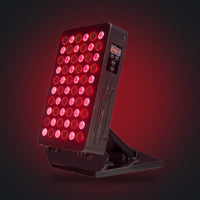
A wrap is any light device that holds its LEDs on the body with a strap, band or sleeve. The AWA red light therapy belt is one example. A panel is a flat frame of LEDs on a stand, door hook or wall mount that you face from a stated distance. The AWA FX300 and FX500 are panels.
The difference is not brightness. It is geometry. A panel throws light across a gap, so the same panel gives a different irradiance at every distance. A wrap closes the gap, so what matters is fit and how many LEDs actually touch the area.
Side by side
| Question | Wrap | Panel |
|---|---|---|
| Where is the light? | Against the body | Away from you at a set distance |
| How much area at once? | What the strap covers | A wider area that depends on distance |
| Do you hold it? | No, it stays strapped on | No, it stands or hangs |
| Can you move around? | Yes, within the cable or battery limit | No, you stay in front of it |
| Space needed | Almost none | Floor or wall space |
| Typical spec | Wavelengths, LED layout, manual | Irradiance at a named distance |
| Best at showing | Fit and comfort | Output comparison |
Why you cannot compare them by LED count
LED count tells you how many emitters there are, not how much light lands on each square centimeter. Two devices with the same LED count can differ widely once you factor in LED power, spacing, optics and distance. The only fair comparison is irradiance in mW/cm² at the same distance, and many wraps do not publish one.
Here is how to read the panel numbers. The FX300 is stated at 83.5 mW/cm² at 6 inches and the FX500 at 94 mW/cm² at 6 inches. At 5 minutes (300 seconds), the formula J/cm² = mW/cm² x seconds / 1000 gives 25.1 J/cm² for the FX300 and 28.2 J/cm² for the FX500. Those are arithmetic from stated specs. A wrap with no irradiance figure cannot be put into the same table, and that is a gap in the spec sheet, not a verdict about the wrap.
Arithmetic example only. These figures describe what a panel emits at 6 inches, not a recommended session.
How a day looks with each format
These are practical scenarios, not guidance on session length. Follow the manual for time and distance.
- At a desk. A wrap lets you stay seated and keep working. A panel needs a clear spot in front of you, and you need to stay roughly the same distance away.
- In a bedroom. A panel on a stand or door hook can cover a wide area while you stand or sit. A wrap works lying down if the cable reaches.
- On the road. A wrap folds into a bag. A panel is bulkier, although a foldable stand helps.
- Shared home. A panel is easy to share because anyone can stand in front of it. A wrap suits one person per session unless you have more than one.
What to check before you buy a wrap
- Which wavelengths are used, for example 660nm red and 850nm near infrared.
- Whether the strap length suits the area you have in mind.
- Whether the controller, cable or battery lets you sit comfortably.
- Whether the manual states a session time and any limits.
- Whether extras can be switched off, if you do not want them.
The belt buying checklist goes through these points in more detail.
What to check before you buy a panel
- Irradiance at a named distance, in mW/cm², not total watts.
- Wavelengths and whether the maker lists the distance range.
- Stand, hook or mount options for your room.
- Whether the remote and timer suit how you want to sit or stand.
- The warranty and the manual. See the irradiance specs guide for how to read the table.
Common mistakes
- Choosing a wrap because it is easier to carry, then wanting it to cover a large area.
- Choosing a panel and then not leaving the floor space to use it at the stated distance.
- Comparing a wrap's LED count with a panel's irradiance as if they were the same measure.
- Wearing a wrap over thick layers when the manual asks for the device against the skin or a thin layer.
- Ignoring the manual for session time, since a blog cannot set it for your device.
Before you use any light or heat device: read the label, follow the device manual, and use eye protection as directed. Ask a doctor first if you have a medical condition, take medications, are pregnant, or have light or heat sensitivity.
Related guides
- Red light therapy formats guide
- What to look for in a red light belt
- AWA FX300 and FX500 irradiance specs
- What irradiance means and why it matters
Device pages
Read the full page and label for each device before you use it: AWA red light therapy belt, AWA FX300 panel, AWA FX500 panel. You can also browse AWA wearable devices.
Frequently asked questions
Is a wrap or a panel better?
Neither is better in general. A wrap suits one area and frees your hands, and a panel suits a wider area from a stated distance. Choose by area, posture and space.
Can I compare a wrap and a panel by LED count?
No. LED count does not tell you how much light lands on each square centimeter. Compare irradiance in mW/cm² at the same distance, when both are published.
Do wraps list irradiance?
Many do not. If irradiance is missing, you cannot calculate J/cm² from the spec sheet, so follow the manual and ask the maker for the figure.
Which format needs more space?
A panel, because it needs floor or wall space and a clear distance in front of it. A wrap needs almost none.
Where do I find session time?
In the manual and on the product page for your device. This guide compares formats and does not set session times.
Sources
- FDA: General Wellness policy guidance. A final guidance dated January 2026 that sets out the agency's compliance policy for low risk general wellness products. It is a policy document, not a statement about any one device.
- FDA: Premarket Notification 510(k). Explains that a 510(k) is a premarket submission and that the company must receive an FDA order before marketing the device in the U.S.
Regulatory note: select devices carry FDA 510(k) clearance for specific, limited uses. Most light devices are sold as general wellness products. Read each product page and label.
How we create this guide
AWA sells red light therapy devices. We write these guides to explain how devices work and how to choose and use one. This is general information, not medical advice. Read each product page and label. See our editorial standards.