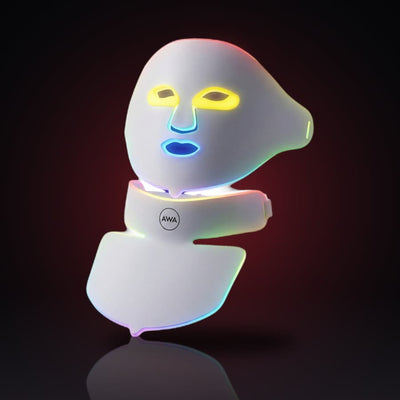
LED Face Mask Specs Explained: LEDs, Wavelengths and Coverage
Published October 2026. Updated October 2026.
Quick answer
A mask spec sheet lists chip count, wavelengths, intensity levels, timer, power and materials. Wavelengths tell you the color of the light, chip count tells you how many emitters there are, and only irradiance at the surface tells you how strong the light is. For the AWA LX500, the product page lists 306 LED chips, three modes, three intensity levels and a 5000mAh battery. Specs describe a device; they do not promise an outcome.
Why mask specs are easy to misread
Most mask listings throw a handful of numbers at you: LED counts, wavelengths in nanometers, battery sizes, timer lengths. Each number answers a different question, and mixing them up is the most common way shoppers end up comparing the wrong things. This guide goes through each spec in turn, says what it tells you, and says what it does not. It is part of our LED face mask series. For the big picture, see the LED face mask guide.
The spec sheet in one table
| Spec | What it tells you | What it does not tell you |
|---|---|---|
| LED chip count | How many emitters are on the mask | How strong the light is, or how evenly it covers the face |
| Wavelengths (nm) | The color of each mode, such as 630nm red, 850nm near infrared, 415nm blue | How much energy reaches the surface |
| Irradiance (mW/cm²) | Power arriving on each square centimeter at a stated distance | A suitable session time for you |
| Modes | Which wavelength combinations you can select | Which one to choose |
| Intensity levels | How many output steps you can pick | The actual output at each step unless it is stated |
| Timer | The session length and whether the mask shuts off automatically | Whether that length suits your situation |
| Battery or cord | How the mask is powered and for how long | Light output |
| Material | Silicone, rigid shell, strap type | Fit on your particular face |
LED chip count
The AWA LX500 product page lists 306 LED chips in total. Chip count matters, but only alongside other numbers. Two masks can have the same count and very different output, because chip size, drive current, spacing and the distance from face to chip all change what lands on the surface.
Wavelengths
Wavelength is the color of the light, measured in nanometers. The AWA masks list 630nm red, 850nm near infrared and 415nm blue. The LX500 combines them into three modes: red plus near infrared, blue, and mixed. The LX300 page also lists additional color modes. Near infrared is invisible, which is worth remembering when you read a mode list: you cannot confirm that mode is running by looking. For a deeper look at two of these wavelengths, read the wavelength comparison guide.
Irradiance and dose
Irradiance is the number that says how strong the light is where it arrives, in mW/cm². It depends on distance, so a figure without a distance is hard to use. Our guide on what irradiance means explains how to read it. We do not publish an irradiance figure for the masks in this guide, so the arithmetic below uses example numbers.
Dose here means energy per square centimeter: J/cm² = mW/cm² x seconds / 1000. Example numbers for arithmetic only: 8 mW/cm² for 10 minutes (600 seconds) is 8 x 600 / 1000 = 4.8 J/cm². A mask with 16 mW/cm² would reach the same 4.8 J/cm² in 300 seconds. That shows why two masks with the same timer can deliver different energy, and why a timer alone is not a comparison. You can try your own figures in the red light dose calculator.
Coverage and chip density
Coverage is how much of the face the lit area reaches and how evenly. A single count of chips does not say. Here is a simple density calculation using example numbers for arithmetic only:
| Example mask | Example chips | Example lit area (cm²) | Chips per cm² |
|---|---|---|---|
| Mask A | 300 | 500 | 0.60 |
| Mask B | 300 | 750 | 0.40 |
| Mask C | 200 | 400 | 0.50 |
In this example, Mask C has fewer chips than Mask A but a density between the two. Density is only a rough guide, since it ignores chip power and spacing, but it is a better question to ask than "how many LEDs".
Modes, intensity levels and timers
The AWA LX500 page lists three modes, three intensity levels and automatic shut off, with a 10 minute session, 3 to 4 times a week. The LX300 page lists about 10 minutes, 3 to 4 times a week. Intensity levels are steps, not units: "level 2" means nothing until the maker states its output. A timer with automatic shut off is a handling feature, since it stops the mask without you watching the clock.
Power and materials
The LX500 page lists a 5000mAh rechargeable battery, up to 100 minutes per full charge, with USB C charging, and a liquid silicone shell for the full face. Battery capacity tells you how many sessions fit between charges, not how bright the mask is. A flexible shell tends to follow the face, while a rigid shell keeps its shape; neither is a measure of output.
Regulatory lines on a spec sheet
Some listings include a regulatory line. FDA classifies devices by risk, and a 510(k) is a premarket submission for a device compared with one already legally marketed. Select devices carry FDA 510(k) clearance for specific, limited uses; most are sold as general wellness products, and masks are cleared for the face only. LEDs are also a different category from lasers: FDA states that LEDs are not subject to the federal laser product performance standard. A regulatory line is not a performance number, so read it separately from the table above.
Common mistakes
- Comparing chip counts across masks and ignoring irradiance.
- Reading a wavelength list as a performance score.
- Reading "3 intensity levels" as a strength rating without a stated output.
- Assuming a bigger battery means a brighter mask.
- Assuming a longer timer is better. A timer is an instruction, not a measure.
- Skipping the manual and the product page for the exact specs of your own device.
Speak to a qualified professional about any medical question. A spec sheet is not a substitute for professional advice.
Related guides
Device pages
Check the current spec list on each product page: AWA LX300 and AWA LX500. You can also browse the masks collection.
Frequently asked questions
How many LED chips does the AWA LX500 have?
The AWA LX500 product page lists 306 LED chips in total. A chip count alone does not say how strong the light is, so read it with the wavelength and irradiance information.
Does a higher LED count mean a stronger mask?
Not by itself. Output depends on chip size, drive current, spacing and distance from the face. The number that describes strength is irradiance in mW/cm² at a stated distance.
What do the wavelength numbers mean?
A wavelength in nanometers is the color of the light. The AWA masks list 630nm red, 850nm near infrared and 415nm blue. The number does not say how much energy reaches the surface.
Why does the near infrared mode look off?
Near infrared at 850nm cannot be seen. Use the mode indicator and the manual to confirm what is running rather than looking for visible light.
Where do I find the exact specs for my mask?
The product page and the manual that came with your device. If a number is not listed there, consider it unknown rather than guessing.
Sources
- FDA: Laser products and instruments. Describes laser hazard classes and states that LEDs are not subject to the federal laser product performance standard.
- FDA: Classify your medical device. Describes device classes I, II and III as a risk based system, and notes that intended use and indications for use affect a device's class.
Regulatory note: select devices carry FDA 510(k) clearance for specific, limited uses; most are sold as general wellness products. Masks cleared for the face only. Read each product page and label.
How we create this guide
AWA sells red light therapy devices. We write these guides to explain how devices work and how to choose and use one. This is general information, not medical advice. Read each product page and label. See our editorial standards.