Is Red Light Therapy FSA Eligible? How to Pay With Your FSA or HSA Card
Short answer: It depends on your plan. AWA accepts FSA and HSA cards at checkout, and you can also pay another way and submit a receipt for reimbursement if your plan allows it. Here's exactly how it works and what to do if your card is declined.
Whether a purchase qualifies depends on your own plan and plan administrator, so check your plan documents.
Are red light therapy devices really FSA/HSA eligible?
Eligibility is set by your plan and the IRS rules for qualified medical expenses, and your plan administrator has the final say. AWA accepts FSA and HSA cards at checkout, and what a plan accepts can depend on the documentation you provide. A few things to know:
- Plan rules decide. Each administrator sets its own documentation requirements.
- Phototherapy equipment: some plans accept it and others do not.
- Face masks: select devices carry FDA 510(k) clearance for specific, limited uses; the LX300 and LX500 face masks are cleared for the face only.
- Documentation: keep your order confirmation and itemized receipt, and ask your administrator what documentation is needed.
The key principle: confirm with your plan administrator before you buy. You can browse AWA's panels, LED masks, sauna blankets, and wearables in the FSA & HSA collection.
How to pay with your FSA or HSA card at checkout
The simplest route takes about a minute:
- Add your device to the cart at awarlt.com and go to checkout.
- At payment, enter your FSA or HSA debit card. It looks and works like any Visa/Mastercard debit card.
- Complete the order. The card is charged directly.
Card acceptance depends on your specific card issuer and plan, so an occasional decline doesn't necessarily mean a product isn't eligible.
What if my card is declined or charged as "regular"?
Some FSA/HSA cards are restricted to certain merchant categories. If yours doesn't go through, you have a backup (reimbursement):
- Pay with any regular credit or debit card.
- Save your AWA order confirmation / itemized receipt.
- Log in to your plan administrator's portal (Optum Bank, HealthEquity, WageWorks, etc.) and submit a reimbursement claim with the receipt.
- Funds are typically returned to your bank account within a few business days.
Whether a reimbursement claim is approved depends on your plan. Need an itemized receipt? Email contact@awarlt.com.
FSA vs. HSA: what's the difference?
| Feature | FSA (Flexible Spending Account) | HSA (Health Savings Account) |
|---|---|---|
| Who can have one? | Employer-sponsored plan holders | Anyone enrolled in a qualifying high-deductible health plan (HDHP) |
| 2026 contribution limit | $3,400 per employee | $4,400 self-only / $8,750 family (+$1,000 catch-up at age 55+) |
| Funds roll over? | Mostly "use it or lose it" (plans may allow up to a $680 carryover for 2026) | Yes: rolls over indefinitely and is yours to keep |
| Red light therapy covered? | Depends on your plan | Depends on your plan |
If you have both, a common strategy is to spend FSA dollars first (they're more likely to expire) and let HSA funds ride. For a deeper account-by-account breakdown, see our FSA vs. HSA guide.
How do pre-tax funds work?
FSA and HSA contributions come out of your paycheck before certain taxes. How that affects what you pay depends on your income, tax bracket, state, and plan. AWA does not give tax advice, so a tax professional can tell you what applies to you. For a price breakdown by device type, see how much red light therapy costs.
Which AWA devices accept FSA/HSA cards?
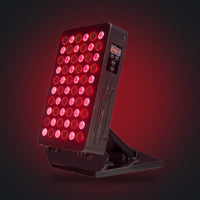
- FX300 Red Light Therapy Panel ($199.99) and FX500 Panel ($269.99), dual 660nm + 850nm.
- LX300 LED Face Mask ($239.99) and LX500 Mask ($279.99). Select devices carry FDA 510(k) clearance for specific, limited uses; the LX300 and LX500 face masks are cleared for the face only.
- HL300 Infrared Sauna Blanket ($159.99) and the HL500 ($399.99). Our guide to choosing an infrared sauna blanket covers both.
- Targeted wearables: the vibrating belt ($119.99), slippers, and torch.
- Browse the FSA & HSA collection →
Not sure which fits your needs and budget? Take the 60-second find-my-device quiz, or browse by format in the red light therapy collection.
Do I need a prescription or extra documentation?
That depends on your plan. Some plans ask for a Letter of Medical Necessity (LMN), a short note from your own provider, and others do not. A letter does not guarantee that a purchase qualifies, and whether one is issued is the provider's own call. Here's how people get an LMN online, and you can read our Letter of Medical Necessity guide to see when a plan may ask for one.
Use it or lose it: don't let FSA dollars expire
Most FSA plans forfeit unspent dollars at the end of the plan year (some allow a short grace period or up to a $680 carryover for 2026). If you have a balance, check your plan's deadline and rules. See 5 reasons to use your funds before they expire.
More FSA/HSA resources
- Letter of Medical Necessity for Red Light Therapy
- Deducting red light therapy on your taxes without an FSA or HSA
- Using FSA/HSA funds for a spouse, parent, or dependents
- Do HSA funds expire?
Frequently asked questions
Can I really buy red light therapy with FSA or HSA money?
It depends on your plan. Your plan administrator has the final say, and some plans ask for additional documentation.
My FSA card was declined. What now?
Pay with any card, keep the itemized receipt, and ask your plan administrator whether you can submit it for reimbursement.
Do I need a prescription?
That depends on your plan. Some plans ask for a Letter of Medical Necessity or other documentation, and others do not.
Can I use my HSA instead of an FSA?
Both accounts follow your plan's rules about what qualifies. HSA funds roll over indefinitely, while most FSA balances do not.
Can I use a dependent care FSA?
No. Dependent care FSAs are only for childcare/dependent care. Use a health FSA or HSA.
This article is general information, not tax or medical advice. FSA/HSA eligibility, contribution limits, and reimbursement rules vary by plan and are set annually by the IRS. Check with your plan administrator for your specific coverage.